Sunday, 20 May 2012

European Cookie Law

Yesterday, Andy Budd tweeted the following:

Wondering if the browsers are doing anything about the EU cookie law? Would be so much slicker if this could be handled at the brower level.

That got me thinking and, as I like to work out how things work, I started to ask Andy how he would see this being implemented. A few tweets later and it's obvious I need more than 140 characters to explain what is going through my mind, hence this post.

Cookie Law, What Cookie Law?

The Cookie Law is a UK law that derives from a European Directive and requires all site owners to disclose their use of cookies and allow visitors to opt in. The law came into force on 26th May last year and the ICO said at the time that it would not enforce it for the first 12 months. Those 12 months come to a close at the end of next week.

Andy's Idea

Andy's idea is to use the browser to handle this law. This is a good idea for the following reasons:

  1. Every single web site has been implementing the law their own way so using the browser would be a good way to bring a bit of standardisation to it;
  2. The browser is the agent that uses and stores the cookies created by web sites so it is the best place to enforce the choice of the user whether to opt in or not and to keep track of that choice between multiple visits.

Operational Outline

So far, so good. Then comes the question: how do you implement such a thing in the browser? At a high level, you need to do the following when visiting a web site:

  • Identify whether the web site falls under the jurisdiction of the Cookie Law;
  • If yes, then identify for each cookie presented by the web site:
    • What is that cookie used for,
    • Whether that use is covered by the exceptions detailed in paragraphs (4)(a) and (4)(b),
    • If not, ask the user for consent.

Let's take all those one at a time to see where we get to.

Jurisdiction

The first step is to identify whether a given web site is subject to the Cookie Law. In order to do this reliably, you would need a cryptographically secure token that can be linked back to a company identity, including a country. Extended Validation Certificates already offer something similar but do they contain a country code in a machine readable format? I simply don't know. And what about sites that use plain HTTP rather than HTTPS?

In all instances, you will have three possible outcome to whether the site falls under the Cookie Law: yes, no or don't know. In the first case, you also need to know what variation of the European Directive to apply. European Directives being what they are, each member country is free to implement it their own way so German law will be different from British law. Conversely, in the last case, what should the browser do? Display a warning or let you go on?

To complicate matters, there is also the question of whether cookies served by a domain other than the main site's domain, such as cookies from ad networks, fall under the main site's jurisdiction or their own domain's jurisdiction. IANAL so I have no idea what the answer is.

Finally, what would prevent a multi-national company to advertise its web site to the browser as being in a non-European jurisdiction even if they do business in Europe?

What is that Cookie for?

The next step is to identify what each cookie is used for. This could take the form of a machine readable file located at a well known URL or referenced by a link tag in the page's header. This was tried before in the form of P3P and it failed to gain traction. Any such standard would have to learn from the issues faced by P3P in order to succeed.

Once this is done, it would be a case of having a number of uses recognised as falling under the exception paragraphs while any other use would require opt in. You would then en up with three possible outcomes regarding whether user opt-in is required for any given cookie served by the web site: yes, no and don't know, the latter being the case if the web site does not provide any information for that particular cookie. This last case will be the controversial one because you can't be too stringent otherwise web sites won't have time to implement the standard but on the other hand you have to at least let the user know that a machine readable privacy use for that cookie is missing otherwise it gives an easy cop out for web sites that don't want to play fair.

Opt-in Management

Once a user has given or declined consent for particular cookies to be stored on their browsers, said browsers can remember such decisions and act accordingly next time the user visits the same web site. It would also be nice if the browser could notify the site of the user's decision so that web sites can avoid creating declined cookies altogether. This should then be accessible to the user in a similar way to saved passwords.

Do Not Track, etc.

A couple of parting thoughts:

  • How should all this interact with features like Do Not Track?
  • How can it be made flexible enough such that it can be extended the day other countries implement similar laws?

Answers on a postcard or in the comments below.

Monday, 2 April 2012

Energy Use

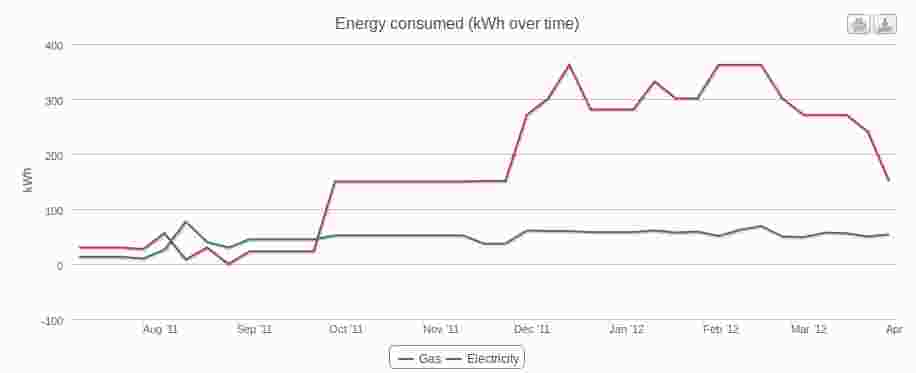
I've been using iMeasure roughly since I moved into the new house and here's what the graphs look like so far:

iMeasure Energy Usage Graph

iMeasure Energy Usage Graph

There are two immediate observations on this graph:

  • electricity use is not seasonnal,
  • gas use definitely is!

The first observation tells me that my main electricity usage is probably not lighting as it doesn't change with the amount of daylight. So it's probably down to the big electrical items such as the washing machine and the fridge. I should be able to reduce that usage the day I replace them with new efficient models. One additional tidbit of trivia: the spike at the beginning of the graph is down to the sanding machines used when I had the wooden floors of the house sanded and varnished.

The second observation tells me that I need to work on insulating the house. In fact, I had thermal imaging done recently by the excellent Sustainable Lifestyles and it showed me very clearly that I have some low hanging fruit to pick first, in particular the loft insulation (or partial lack thereof) that results in very cold spots above the bay window in the master bedroom:

Cold Spot Above Bay Window

Cold Spot Above Bay Window

And at the junction points between walls and roof, the fact that whoever fitted the insulation in the loft didn't bother to fit it properly at the bottom causes cold spots underneath:

Cold Spots Where Wall Meets Roof

Cold Spots Where Wall Meets Roof

All this should be reasonably easy to fix so that will be my project for the summer and hopefully it should shave some of that spike off the graph for next year.

Sunday, 15 January 2012

Recycling Smoke Alarms

We all know that we should have smoke alarms fitted in our homes. Those alarms can be damaged and will need replacing every ten years or so anyway. So what do you do with the old ones? Chuck them in the bin? Well, the fact that they are the subject of a best practice guide on the National Household Hazardous Waste Forum suggests that this is probably not the right solution. And indeed, looking at the back of mine, I can see why:

The back of my smoke alarm showing that it is a ionization alarm that contains a small amount of radioactive Americium 241

Ionization smoke alarms contain a small amount of radioactive material, Americium 241. Looking back at the best practice guide above, there are apparently three ways to deal with it:

  1. By a person authorised under section 13 of the Radioactive Substances Act 1993,
  2. By returning it to the manufacturer,
  3. By chucking it in the bin as long as you don't chuck in other radioactive waste and you only throw away one smoke alarm per bin bag.

Option 3 doesn't sound like recycling, while I don't know anybody who can help me with option 1. So that leaves option 2. As I've got the manufacturer's details on the back of the alarm, and their address is confirmed on their web site, that smoke alarm is going to find itself put into a jiffy bag, back to where it came from.

Note that there is another type of smoke alarms: photoelectric ones. They do not contain any dangerous material so are probably safer to dispose of. However, they are geared to detect different types of fires so for maximum protection you should have a combination of both photoelectric and ionization alarms.

For more questions on recycling stuff, have a look at the Recycle This web site.

Update

As very sensibly pointed out by Earth Notes, there may be an even easier way to deal with them: under the WEEE Directive, you can probably just give the old one to the retailer when you buy a new one.

Friday, 13 January 2012

Yodel redefines the word Safe while John Lewis redefines Eco-Friendly

Last week-end I visited the John Lewis web site and bought a couple of Buiani folding chairs. I was advised that they would be delivered within 7 days via a standard delivery service, as opposed to the specialist delivery service you get when you buy larger items and who are very good.

So when I came back home on Wednesday night, I found a very large (more on that later) cardboard box outside my front door and in the letter box was this delivery notice:

Yodel delivery notice

Yodel delivery notice

You will note how they checked the a safe place box. They actually left the parcel outside my front door. Luckily I live in a relatively safe place so theft is unlikely. On the other hand, leaving an unprotected cardboard box outside, in London, in January, with something inside that may suffer from getting wet strikes me as a tad optimistic. Or did check the weather forecast before leaving the box outside?

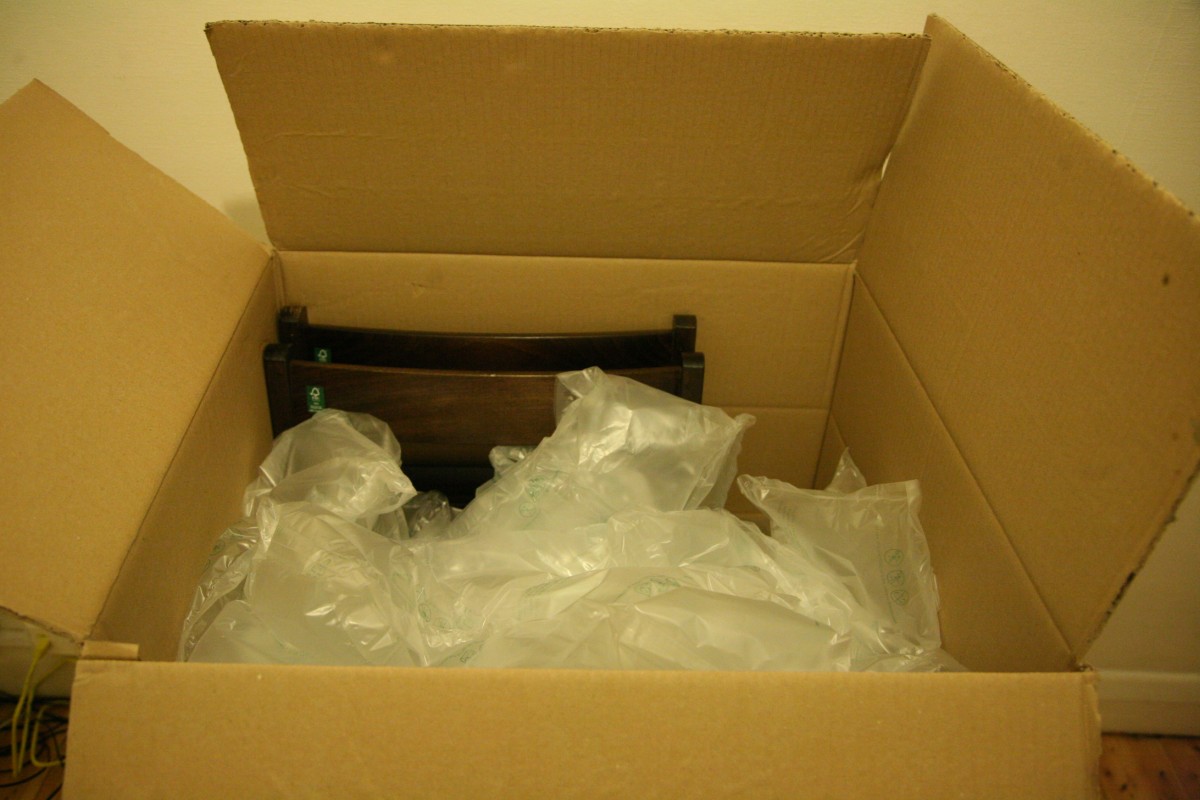
Another thing that I found rather puzzling was the size of the box. It would have made sense had it contained normal chairs. But folding ones: surely they'd be shipped folded? All was revealed when I opened the box:

The big box

The big box

You will note the green stickers on the left side of the chairs with the FSC logo advising me that those chairs are made from wood from well-managed forests. Brilliant! Unfortunately the amount of Air Pad packaging filling in the box probably offsets all eco-friendly credentials imparted by the FSC logo. On the plus side, it probably means that I now have enough air pads to send presents to my two nieces until they reach adult age (uncles are meant to spoil nieces and nephews, that's part of the job description).

Friday, 30 December 2011

Non-Exchangeable, Non-Refundable

I travelled on Eurostar today and learnt something about non-exchangeable, non-refundable tickets in the process so thought I'd share in case it can be useful to someone else. Eurostar sells several types of tickets in several classes (Standard, Standard Premier and Business Premier). The higher the class and the more flexible the ticket, the greater the price. So the cheapest tickets are non-exchangeable, non-refundable standard class tickets. Once bought, such tickets cannot be exchanged against another on a different train, cannot be refunded in case you don't want to travel anymore but they can most certainly be upgraded to the next travel class up, as I did today. Of course, it requires you paying an upgrade price, which may not be cheap. The fact that you can upgrade any ticket makes sense because:

  • An upgrade doesn't fall under the non-refundable rule because you're not asking for a refund, and in fact you're paying extra for the upgrade;
  • It doesn't fall under the non-exchangeable rule either because you're not asking for an exchange as you still want to travel on the same train at the same date: you just want to upgrade your existing ticket.

So if you ask general information staff in the station and are told that you cannot upgrade your ticket, don't take their word for it, go to the sales counter. The only reason why you would not be able to upgrade (and pay Eurostar more money) is if the travel class you want to upgrade to is already fully booked on your train.

Saturday, 28 May 2011

Crash of the Day

Received today from a colleague:

Please note that if somebody opens Build log excel in Microsoft excel 2007 and updates it while a filter put on any column, the file crashes.

So please avoid updating the build log in Microsoft excel 2007.

So we're talking about a fairy simple file created in Excel 2003 that crashes Excel 2007 if you try to update it while a filter is set on any column... Sigh...

Thursday, 21 April 2011

MS Works to MS Word: LibreOffice to the Rescue

I am at my mum's for Easter and one of the first things she asked me to look at had to do with her computer. She had this document that she wrote using Microsoft Works aeons ago that she wanted to open again. Of course, she's now using Microsoft Word and Word has no idea how to open Works files, even though both products are produced from the same software company.

What to do? The answer is very simple but rather counter-intuitive for people not used to open source software: LibreOffice. From the point of view of someone who lives in a world where closed source is the norm, how can a free office wannabe solve a problem that the mighty MS Office can't solve? Simple: as highlighted by Michael Meeks at FOSDEM earlier this year, LibreOffice wants to have the largest possible list of supported file formats so that they can support their users in reading their old documents stored in long forgotten format and hopefully migrate them to modern and preferably open document formats. As a result, LibreOffice supports MS Works and MS Word out of the box.

So back to my mum's document, retrieving the content was then very easy: copy the document to a USB key, open it on my laptop using LibreOffice, save it again and copy the new document back to her PC. In this case, it meant saving it back as an MS Word document. In an ideal world, I would have saved it as ODF and installed LibreOffice on her computer but I'll leave that for another day.

So if you have any old document lying around that you can't open anymore, try LibreOffice first, you'll be surprised how many weird and wonderful formats it supports. If it still doesn't work, consider contributing a filter to the project or at least reporting the issue and providing sample files so that the developers can build such a filter.

Tuesday, 1 February 2011

Outlook Error

In the meaningless error category, let me present today's effort by Microsoft Outlook:

Task 'Microsoft Exchange Server' reported error (0x8004010F): 'The operation failed. An object could not be found.'

Sunday, 30 January 2011

D-Bus Experiments in Vala

Most modern Linux desktop distributions now include D-Bus. It enables different applications in the same user session to communicate with each other or with system services. So I thought I'd experiment with D-Bus using Vala and starting with the published example.

Example 1: Ping Loop

I started with a simple ping client and server based on the example above, the main difference being that I added a loop in the client. The server code takes a message and an integer, prints out the message and the received integer, then adds one to the integer before returning the result:

[DBus (name = "org.example.Demo")]
public class DemoServer : Object {

    public int ping (string msg, int i) {
        stdout.printf ("%s [%d]\n", msg, i);
        return i+1;
    }
}

void on_bus_aquired (DBusConnection conn) {
    try {
        conn.register_object ("/org/example/demo",
            new DemoServer ());
    } catch (IOError e) {
        stderr.printf ("Could not register service\n");
    }
}

void main () {
    Bus.own_name (
        BusType.SESSION, "org.example.Demo",
        BusNameOwnerFlags.NONE,
        on_bus_aquired,
        () => {},
        () => stderr.printf ("Could not aquire name\n"));

    new MainLoop ().run ();
}

server.vala

And the client simply queries the server in a loop every second and prints out the input and output values:

[DBus (name = "org.example.Demo")]
interface DemoClient : Object {
    public abstract int ping (string msg, int i)
        throws IOError;
}

void main () {
    int i = 1;
    int j;
    while(true) {
        try {
            DemoClient client = Bus.get_proxy_sync (
                BusType.SESSION, "org.example.Demo",
                "/org/example/demo");

            j = client.ping ("ping", i);
            stdout.printf ("%d => %d\n", i, j);
            i = j;

        } catch (IOError e) {
            stderr.printf ("%s\n", e.message);
        }
        Thread.usleep(1000000);
    }
}

client.vala

Compiling both programs requires the gio-2.0 package:

$ valac --pkg gio-2.0 server.vala
$ valac --pkg gio-2.0 client.vala

Start the server followed by the client in two separate terminal windows and you should see them exchange data.

Example 2: Graceful Termination

The problem with the code above is that if the server process terminates while the client is still running, an exception occurs and the client doesn't recover. It would be nice if we could get the client to terminate gracefully when the server stops. The Vala GDBus library provides the ability to detect when a service comes up or is brought down using watches. When you setup a watch, you need a callback method for the watch to call. That callback method needs to be called on a different thread than the main client thread. This is handled by the MainLoop class but it means that the core client loop needs to be run in its own thread, which complicates the client code a bit. In the code below, the client code has been encapsulated into a Demo class and the client loop thread is controlled using a simple boolean attribute.

[DBus (name = "org.example.Demo")]
interface DemoClient : Object {
    public abstract int ping (string msg, int i)
        throws IOError;
}

public class Demo : Object {
    private bool server_up = true;
    
    private DemoClient client;
    
    private uint watch;
    
    private MainLoop main_loop;
    
    public Demo() {
        try {
            watch = Bus.watch_name(
                BusType.SESSION,
                "org.example.Demo",
                BusNameWatcherFlags.AUTO_START,
                () => {},
                on_name_vanished
            );
            client = Bus.get_proxy_sync (
                BusType.SESSION,
                "org.example.Demo",
                "/org/example/demo");
            server_up = true;
        } catch (IOError e) {
            stderr.printf ("%s\n", e.message);
            server_up = false;
        }
    }
    
    public void start() {
        main_loop = new MainLoop();
        Thread.create(() => {
            run();
            return null;
        }, false);
        main_loop.run();
    }
    
    public void run() {
        int i = 1;
        int j;
        while(server_up) {
            try {
                j = client.ping ("ping", i);
                stdout.printf ("%d => %d\n", i, j);
                i = j;
            } catch (IOError e) {
                stderr.printf ("%s\n", e.message);
            }
            if (server_up)
                Thread.usleep(1000000);
        }
        main_loop.quit();
    }
    
    void on_name_vanished(DBusConnection conn, string name) {
        stdout.printf ("%s vanished, closing down.\n", name);
        server_up = false;
    }
}

void main () {
    Demo demo = new Demo();
    demo.start();
}

client.vala

The server code is unchanged.

With this version, once the server and client are started, stopping the server through CTRL-C will notify the client which will then stop gracefully. You can even have multiple clients, they will all stop in the same way. The advantage of doing this is that the client has a chance to clean up any resource it holds before stopping.

Example 3: Peers and Service Migration

All of the above is great and we can now design client programs that share a common service. But when dealing with software that is started by the user, the client/server model is not always the best option: you need to ensure that the server is started before any client is and that it is only stopped after the last client has stopped. And what happens is the server fails? What would be really nice is if we could have peers: no difference between client and server, just a single executable that can be run multiple times, the first process to start acts as a server for the other ones and when it stops responsibility for the service is taken over by one of the other processes if any are still running. The last process to terminate closes the service. D-Bus makes it easy to implement for the following reasons:

  • Only one process can own a service;
  • All service calls go via D-Bus so a client process will not notice if the server process actually changes, as long as the service is still available;
  • The client and server processes can be the same process or different processes, it makes no difference to the client.

Therefore, the implementation of the peer program is simple:

  • Start the server, followed by the client and ignore any failure in starting the server: if another process has already started, the service will be available to the client;
  • When the peer is notified of the loss of service, try to start the server but ignore any failure: if another process was notified first, it will have started the server and there will be no interruption in service for the client thread.

We only need a single Vala file to implement the peer:

[DBus (name = "org.example.Demo")]
interface DemoClient : Object {
    public abstract int ping (string msg, int i)
        throws IOError;
}

[DBus (name = "org.example.Demo")]
public class DemoServer : Object {

    public int ping (string msg, int i) {
        stdout.printf ("%s [%d]\n", msg, i);
        return i+1;
    }
}

public class Demo : Object {
    private DemoClient client;
    
    private uint watch;
    
    public Demo() {
        // nothing to initialise
    }
    
    public void start() {
        start_server();
        start_client();
        new MainLoop().run();
    }
    
    public void start_client() {
        try {
            watch = Bus.watch_name(
                BusType.SESSION,
                "org.example.Demo",
                BusNameWatcherFlags.AUTO_START,
                on_name_appeared,
                on_name_vanished
            );
            client = Bus.get_proxy_sync (
                BusType.SESSION,
                "org.example.Demo",
                "/org/example/demo");
            Thread.create(() => {
                run_client();
                return null;
            }, false);
        } catch (IOError e) {
            stderr.printf ("Could not create proxy\n");
        }
    }
    
    public void run_client() {
        int i = 1;
        int j;
        while(true) {
            try {
                j = client.ping ("ping", i);
                stdout.printf ("%d => %d\n", i, j);
                i = j;
            } catch (IOError e) {
                stderr.printf ("Could not send message\n");
            }
            Thread.usleep(1000000);
        }
    }
    
    public void start_server() {
        Bus.own_name (
            BusType.SESSION,
            "org.example.Demo",
            BusNameOwnerFlags.NONE,
            on_bus_aquired,
            () => stderr.printf ("Name aquired\n"),
            () => stderr.printf ("Could not aquire name\n"));
    }
    
    void on_name_appeared(DBusConnection conn, string name) {
        stdout.printf ("%s appeared.\n", name);
    }
    
    void on_name_vanished(DBusConnection conn, string name) {
        stdout.printf (
            "%s vanished, attempting to start server.\n",
            name);
        start_server();
    }

    void on_bus_aquired (DBusConnection conn) {
        try {
            conn.register_object (
                "/org/example/demo",
                new DemoServer ());
        } catch (IOError e) {
            stderr.printf ("Could not register service\n");
        }
    }
}

void main () {
    Demo demo = new Demo();
    demo.start();
}

peer.vala

Start several peers in different terminal windows, at least 3 or 4. You will notice that the first process starts a server thread that all client threads connect to. When the process that provides the service terminates, the next process in the chain takes over the responsibility for the service. And finally, when the last process terminates, the service is closed.

Note that if you want to check D-Bus activity while running the programs in this introduction, you can either install the D-Feet tool or run dbus-monitor from the command line.

The Devil's in the Details

A good piece of software should make boring, repetitive and error prone tasks easy. One of them that photographers face regularly is resizing a batch of images. The typical situation is the day after a party when everybody wants a copy of the photos you took, either by email or on a CD. Quite often, people don't want the full size but they'd quite like copies of all the photos. I found myself in such a situation on New Year's Day: 150-odd photos that needed resizing and burning to a CD. Luckily, I had my trusty Ubuntu laptop running Shotwell. Shotwell does exactly the right thing when you want to export photos: it allows you to resize them all to a size that you specify, as shown in the dialog below:

Shotwell's export dialog

Shotwell's export dialog

My laptop took a few minutes to resize all 150 photos when I exported them. Next to me was a friend who uses a proprietary operating system that shall remain nameless and who commented: Wow, that's cool! When I do that, I have to resize each photo manually and it takes ages! Sometimes the best features are the simple ones.